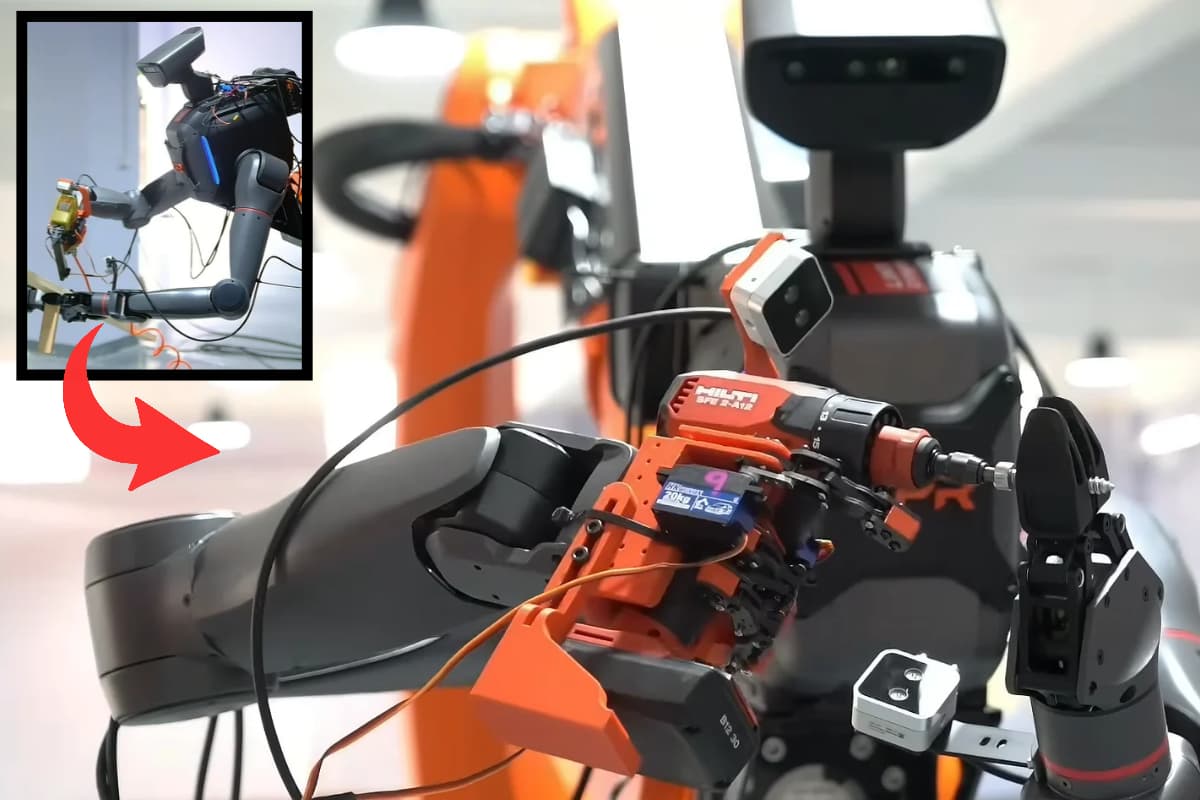
Hybrid Robot for Construction
Construction robotics has just taken a huge leap in innovation… Can a robot use a drill like a human? Straight up, yes — and much more besides!
Actually, they have presented a hybrid construction robot that is basically a “handyman on site” when it comes to handling conventional tools.
The innovative startup of physical AI ZiNova Labs is responsible for moving from theory to real physical work by developing a layer of hardware and software to recognize, hold, and operate tools with different robotic bodies.
So how does it manage to actuate those tools? The company explains that it starts with cordless tools with a grip and a trigger. A gripper holds the tool and a mechanism pulls the trigger. A simple approach to understand, though it requires coordinating the grip, the movement and the contact with the material.
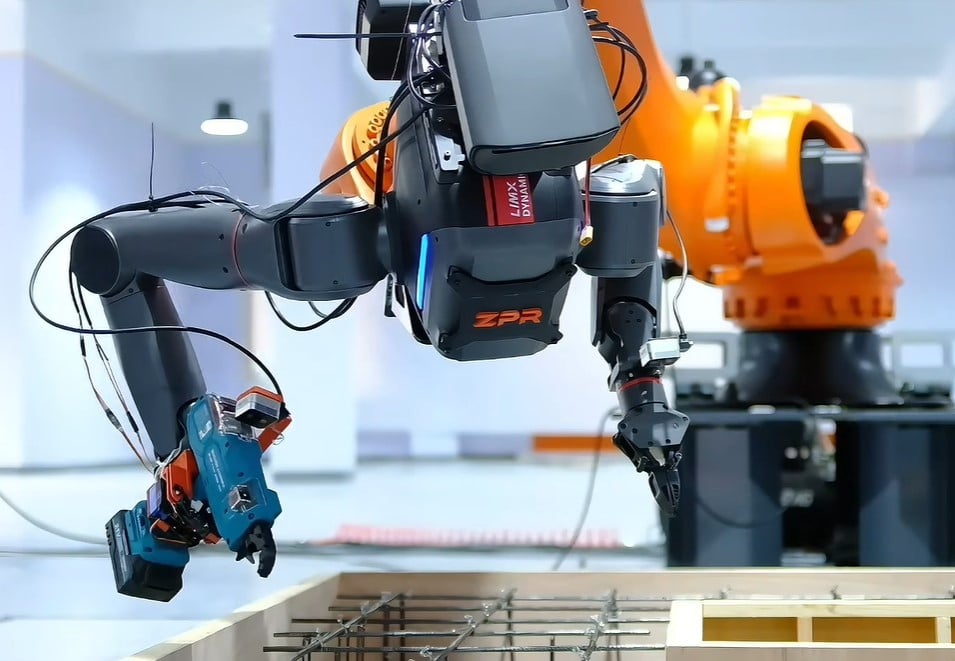
Add to that the dual-arm robot, TRON 2 from LimX Dynamics. Two arms to work with and one big industrial arm — the combo is perfect!
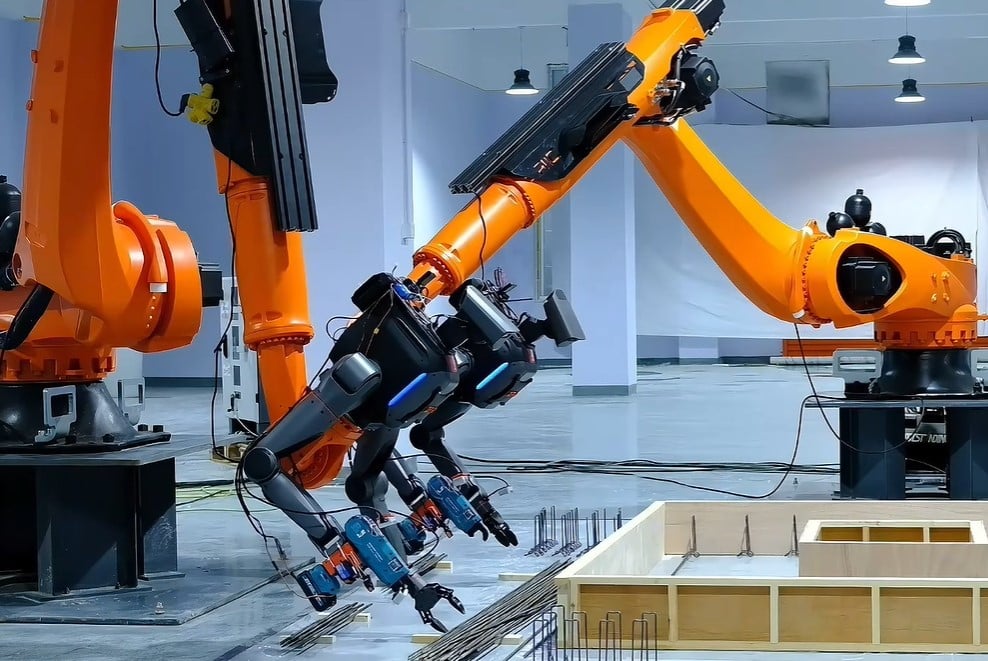
In the presentation, the system takes part in manufacturing a small-scale reinforced concrete panel. It assembles the formwork, carries out drilling, works with the rebar and smooths the concrete.
The trial reproduces part of the tilt-up system, used in industrial buildings and data centers: the panels are prepared horizontally and, once the concrete has hardened, they are lifted into their final position. Here a small-scale segment is being tested.
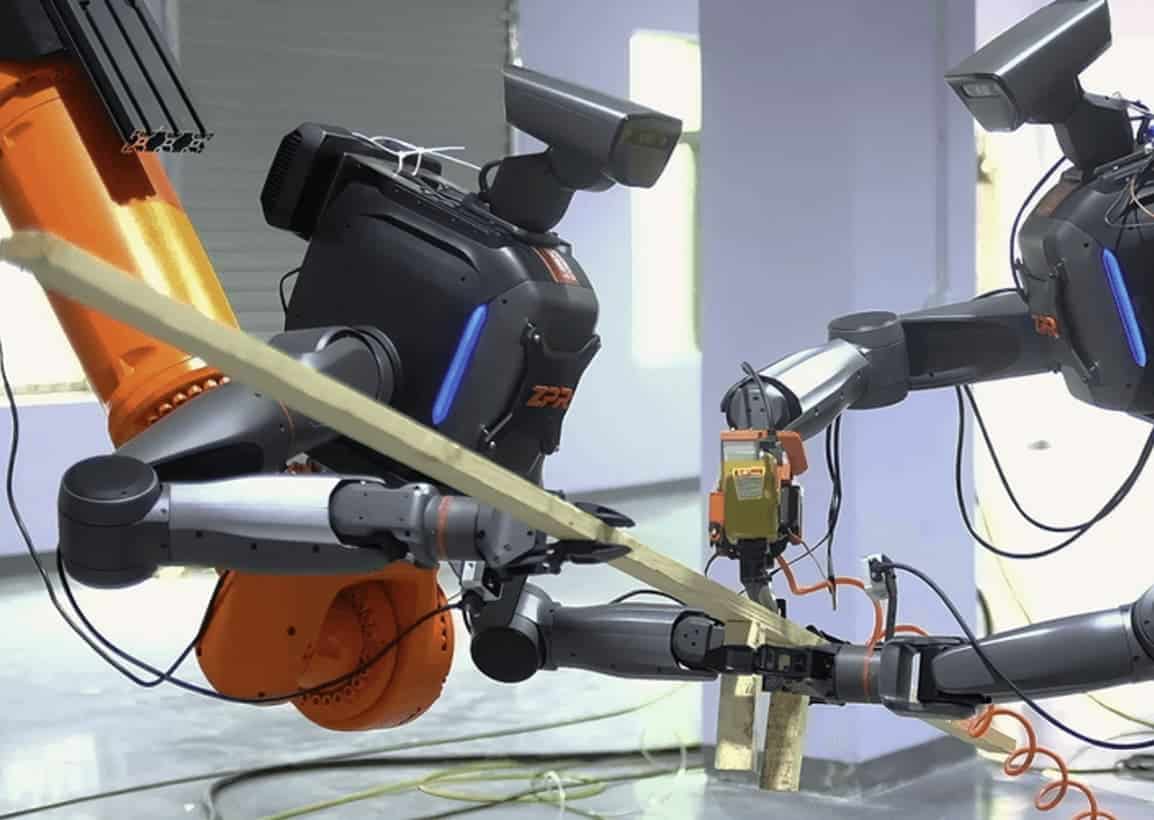
On top of that, LimX Dynamics describes a demonstration with two robots working together. While one handles a nail gun, the other places the formwork boards. Afterwards, both take part in placing and tying the rebar.
The assembly splits up the functions. The large industrial joint moves and orients the upper section; the two smaller arms take care of handling tools and materials.
The head serves to position the camera, and the two arms respond to the need to work with two hands, human-style — which is more efficient!
The spokesperson states that this configuration makes it possible to reach points located between 15 and 30 feet, roughly between 4.6 and 9.1 meters.
The technology with artificial intelligence that coordinates is called Tool Intelligence. The hybrid robot is one of the experimental configurations testing that idea.
The startup also incorporates the TEISI software, an interface designed to capture force, torque, vibration and resistance during contact between robot, tool and material, in the style of the tile-laying machine.
The research is organized around three areas: Grasp, Feel and Form. The first tackles how to hold the tools; the second, how to perceive what happens while using them; and the third, what physical shape the robot needs in order to carry out the work.
And here another important piece shows up: the data generated by each operation. Forces, vibrations, contact and movements can be used to train and evaluate the systems. The company plans to leverage that information to progressively expand the range of tools and tasks its robots are able to handle.
Does it work completely on its own? That level of autonomy throughout the whole process has not yet been demonstrated. LimX Dynamics considers teleoperation so that a person can step in when unexpected situations arise — we’re talking about human-supervised autonomy!
Regarding employment in the style of the domestic humanoid robot, the company’s discourse points to the lack of skilled workers and the physical wear of trades. Their stated intention is to help cover tasks and reduce that burden on people.
Construction is their first testing ground, the startup also considers applications in manufacturing, energy, maintenance, and infrastructure
For now, the image left by this test is very concrete: a robot mounted on another robot, using tools we already know. The challenge will be to make that combination work repeatedly when materials and site conditions change.