Guide to buying solar panels
I have seen that many users ask about buying photovoltaic panels comparing prices, and this is the first lesson: you are on the wrong track! The field of renewables is a bit more complex.
And if we add that the technology of solar panels changes at a giant pace – including their purchase prices – we cannot be careless, we must avoid surprises!
1.- Incorrectly comparing prices
This is the most common; you go to the store, look at the solar panel offer of the week, and buy thinking you have a “bargain.” Your budget cannot be based on the “price per panel.”
You cannot directly compare the total price of a 500 W panel with a 600 W one. You have to look at euros per watt (€/W).
The key to getting it right when buying a solar panel is to look at the euros per watt (€/W) ratio. Two panels may cost the same, but if one generates 450 W and the other 550 W, the real value is different.
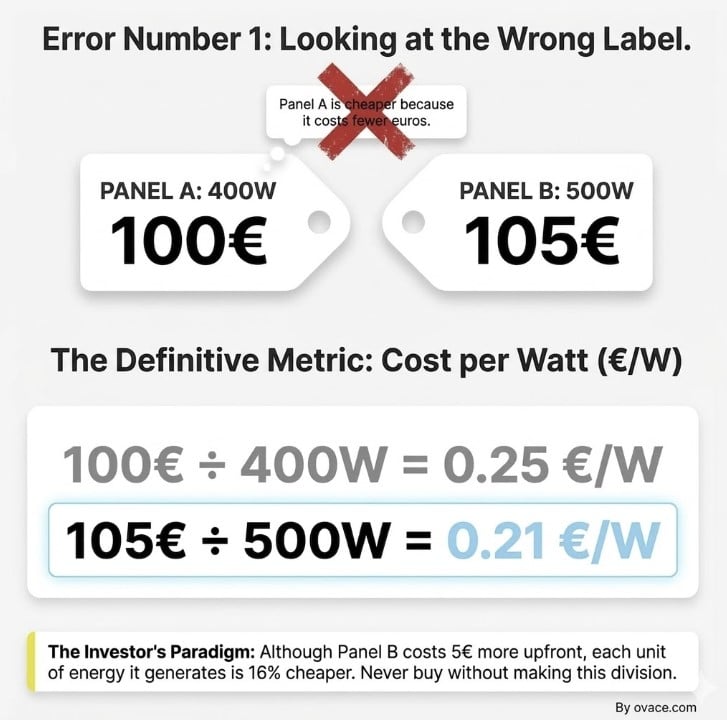
How to calculate the real cost: The euros per watt (€/W) metric
To calculate it, you must divide the total price by the wattage (nominal power), that is, apply the following formula in the purchase of the photovoltaic panel: Price per Watt (€/W) = Panel Cost (€) / Panel Power (W)
- For example, if a 400 W panel costs 110 €, you will be paying 0.275 €/W. However, if a 500 W panel costs 115 €, the real cost is 0.23 €/W, making it a more economical option.
2.- The temperature coefficient
An important factor that is not taken into account is the temperature coefficient (STC) in solar panels. A solar panel does not work better because we have more sun; in fact, heat is its enemy.
The temperature coefficient (STC – Standard Test Condition) is in the technical sheet and is measured in % per ° C. It indicates what percentage of power is lost for each degree that exceeds those 25ºC.
The power temperature coefficient – is in the technical sheet – is measured in % per ° C: the lower, the more efficient and it will work better in summer!
How to calculate losses due to operating temperature? Example, if a panel has a coefficient of -0.30% / ºC, and it is at 65°C (40 degrees above the standard), you will lose 12% (40 x 0.30) of its nominal power just due to heat.
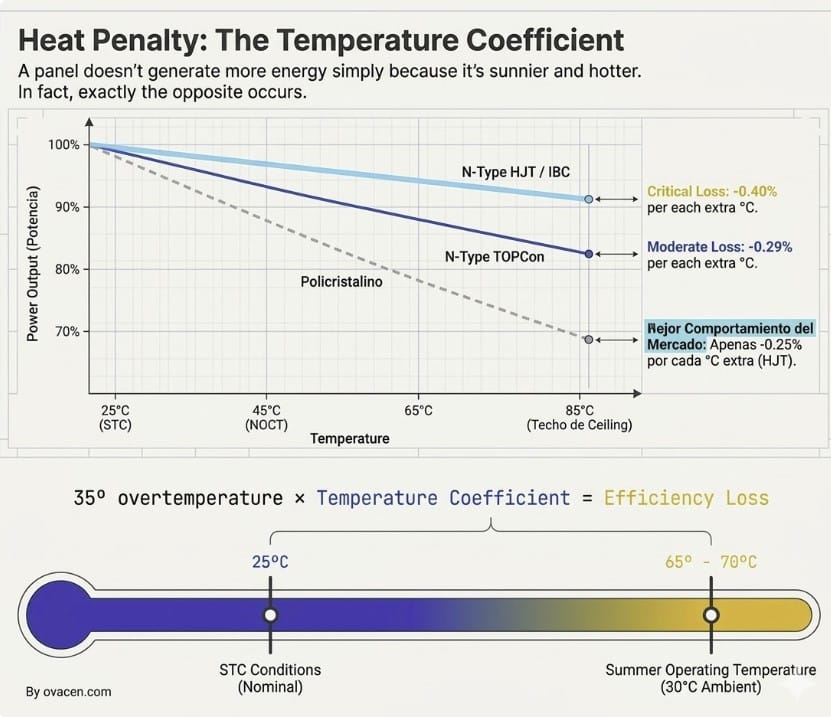
| Panel quality | Equivalent usual technology | Expected temperature coefficient |
|---|---|---|
| Premium Range / Good Quality | HJT, TopCon, ABC (N-Type) | -0.24% to -0.29% / ºC |
| Mid Range | Monocrystalline PERC (P-Type) | -0.34% to -0.37% / ºC |
| Old / Low Quality | Polycrystalline | -0.40% to -0.45% / ºC |
Why is heat the enemy of solar panels? At higher temperatures, silicon becomes more conductive, reducing the output voltage and, therefore, the total power. Efficiency drops drastically every degree above 25°C.
A very high coefficient will make the panel perform worse in summer, while a reduced coefficient will allow better performance during hotter times
🟧 Note: Do not install a panel system on that slate roof or dark surfaces, as it will add more heat in summer, please! An intriguing alternative is the Archimedes wind turbine; it’s definitely worth testing out.
3.- Sizes, applications, and power
The real choice of the panel will depend exclusively on your application. The market has clearly segmented to optimize logistics and installation:
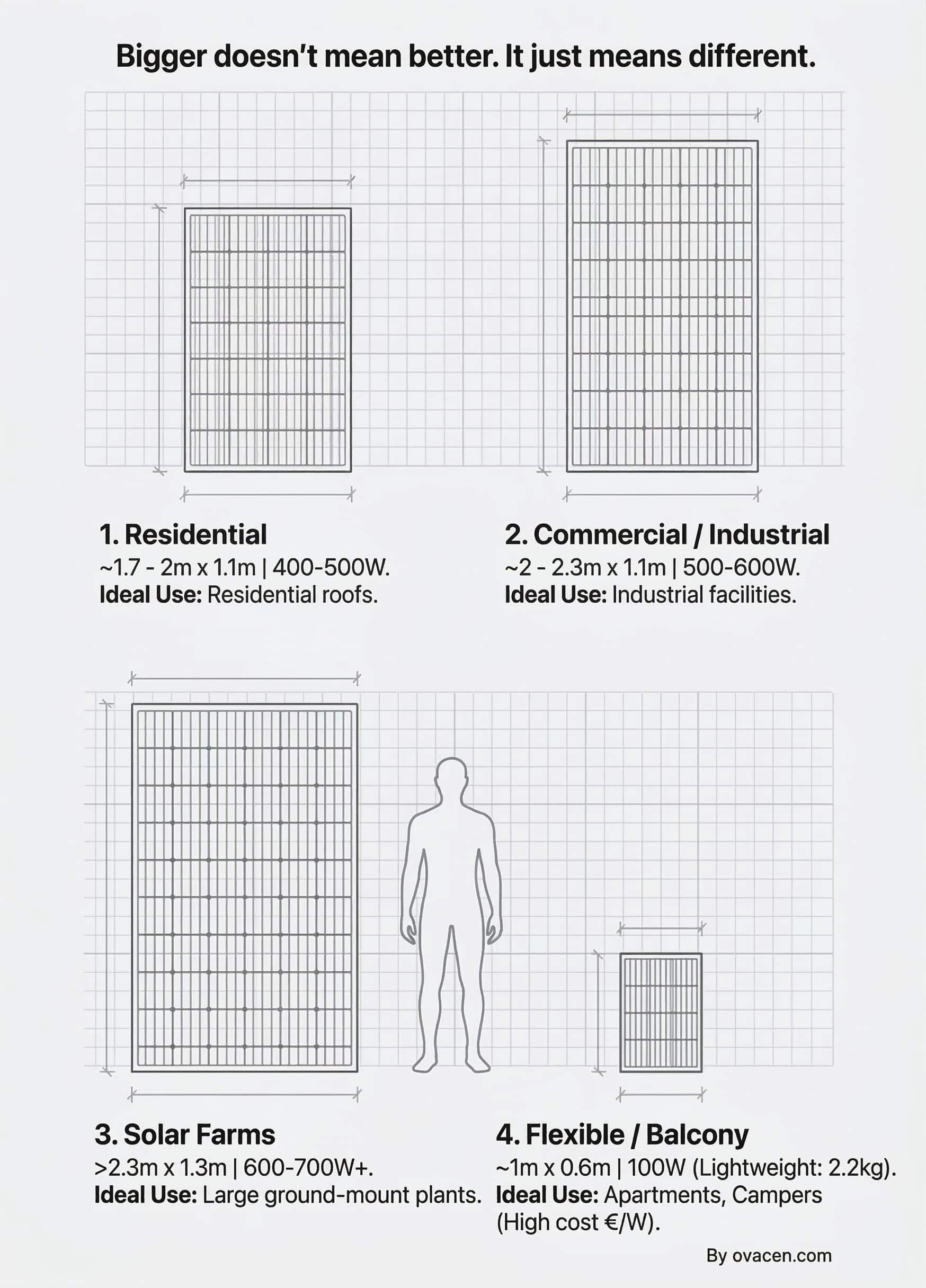
| Application | Typical power | Approx. dimensions | Weight |
|---|---|---|---|
| Residential | 400 – 500 W | 1.72 x 1.13 m | 20 – 22 kg |
| Industrial / Commercial | 500 – 620 W | 2.25 x 1.13 m | 28 – 32 kg |
| Solar Farms | +600 W | 2.38 x 1.30 m | +35 kg |
| Balconies / Camping | 20 – 150 W | Variable (Flexible) | 2 – 5 kg |
When we talk about a solar panel installation, mistakes are made
3.1.- Residential panels (400W – 500W)
These are the ideal modules to install on a house roof. Their dimensions range between 1.70 and 2 meters long by 1 to 1.1 meters wide, offering power from 400 to 500 W in high-efficiency models.
3.2.- Industrial and commercial modules (500W – 600W)
Designed for industrial building roofs. These panels measure between 2 and 2.3 meters long by 1 to 1.1 meters wide. Their standard power is between 500 and 600 W.
3.3.- Solar farms and large plants (+600W)
These are giant modules designed mainly for huge photovoltaic plants. They usually exceed 600 or 700 W of power, with approximate dimensions of 2.3 meters long by 1.3 meters wide.
3.4.- Flexible and small panels for balconies
Outside of commercial standards, there are small panels (20 W or 100 W) that can measure only 1 meter by 60 centimeters. They are very light (about 2.2 kg) and ideal for installations on balconies, caravans, or campers (higher prices).
🟧 Note: If you are going to proceed with a self-consumption system installation for your home, I recommend checking the article to avoid errors in solar installations.
4.- Efficiency and power density
The efficiency in a solar panel is not “how much energy it produces” in total, but how much energy it produces per square meter (Check out solar windows: characteristics and benefits). Power density and efficiency distinguish a good panel from a mediocre one.
Years ago, the dominant technology was polycrystalline, now all the panels you find are monocrystalline. We are on the wrong track if they offer you a polycrystalline one!
Currently, within monocrystalline technology, the market has advanced from P-Type technology to N-Type, and highly efficient sub-technologies such as HJT, ABC, and TopCon have emerged.
The efficiency of solar panels by technology can be seen in the following table:
| Cell Technology | Efficiency Range | Heat Tolerance | Market Status |
|---|---|---|---|
| Polycrystalline / P-Type | 15% – 19% | Low (-0.40%/°C) | Commercially obsolete |
| N-Type TOPCon | 21% – 23.8% | Medium-High (-0.29%/°C) | Dominant in commercial volume |
| N-Type HJT (Heterojunction) | 21.2% – 23.6% | Excellent (-0.25%/°C) | Leader in thermal performance |
| N-Type IBC / XBC (Back-Contact) | 22.0% – 25.0% | High (-0.26%/°C) | The current elite of the market |
- TopCon (Tunnel Oxide Passivated Contact): The dominant technology today. It offers efficiencies of 21-23.8% at a very balanced cost.
- HJT (Heterojunction): More efficient (21-24%) and with a better temperature coefficient, but slightly more expensive.
- ABC (All Back Contact): The front is completely clean, without those fine metallic lines “busbars” that cast shadows. Efficiency between 22% – 25%, but expensive. By taking advantage of 100% of the surface to capture light, power density is maximized, making it ideal for roofs with limited space.
To give you an idea, for example, Oxford PV launched a residential solar module with a record efficiency of 26.9%. You can check the list of the most efficient solar panels for this year in the following image:
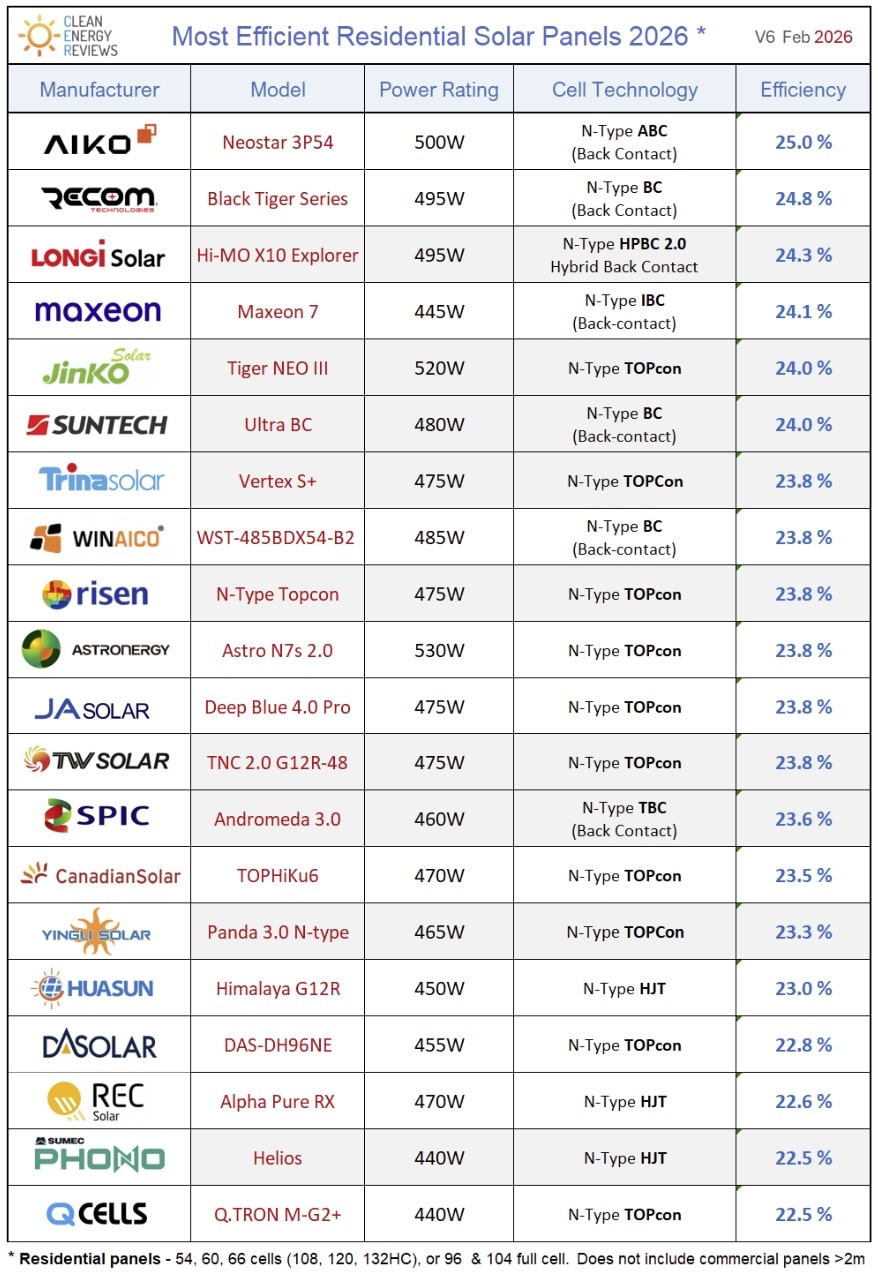
Top brands in photovoltaic panels are AIKO, RECOM Technologies, LONGi Solar, Maxeon, JinkoSolar, Suntech, Trina Solar, WINAICO, Risen Energy, etc. The higher the quality, the more expensive the panel, that’s the reality!
🟧 Note: The shadows that can fall on a panel (see sun path on a house), are a problem. Current efficient panels (like the TopCon or HJT we mentioned) usually come in “Half-Cut” cell format where the impact of the shadow is less.
5.- Degradation of the photovoltaic panel
No panel performs the same in year 1 as in year 20. However, the technological gap has changed the rules of the game…. What is the degradation curve and how does it affect in the long term? Panels suffer from two types of degradation:
- LID (Light-Induced Degradation): Occurs in the first hours. In N-Type technology, it is almost 0.
- Annual degradation: Chemical and physical wear. Standards more or less guarantee losses of only 0.4% annually.
Investing in panels with low degradation (N-Type) means that after 25 years you will still be producing 87-90% of the initial power, compared to 80% of old panels. This can mean many additional euros in energy savings during the end of the useful life.
6.- Solar panel warranty
At this point, we have a very detailed article on the warranty of solar panels, so it is not necessary to go into much detail. Look at the following image to understand the key points:
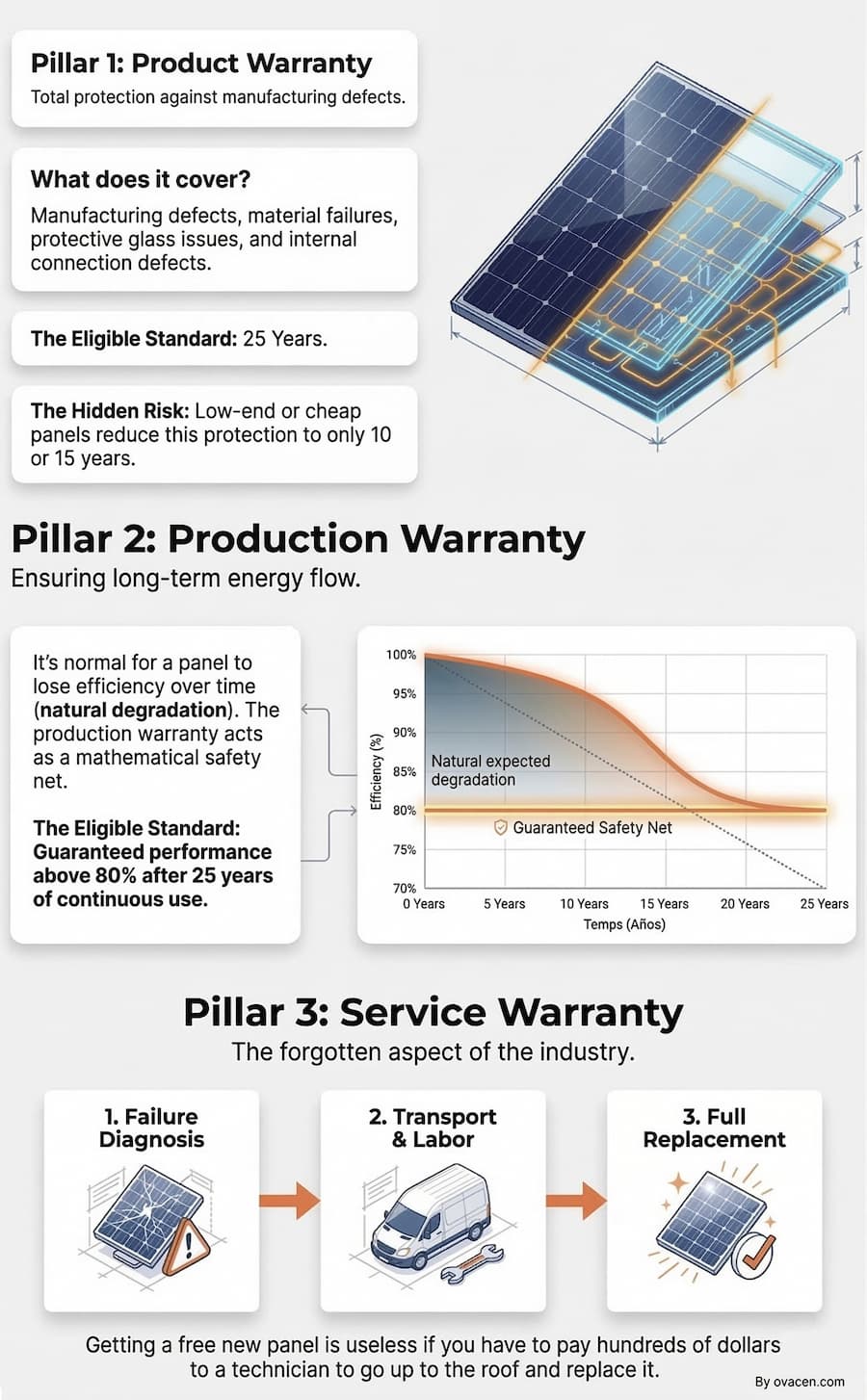
Key differences between performance warranty and product warranty
- Product Warranty: Covers manufacturing defects (a frame that bends, a junction box that fails). It is usually 12 to 25 years.
- Performance Warranty: Ensures that the panel will produce a specific % after X years.
Another topic is to look at the warranty to see what happens with solar panels in extreme weather events (severe hail, wind storms) or thefts, which are quite common lately!
Be careful! If a panel fails physically at 15 years but only has 12 years of product warranty, the performance warranty will be of no use to you.
7.- Consider legality, subsidies, and alternatives
It is necessary to declare and legalize any photovoltaic system in Spain, even isolated installations (not connected to the grid).
The issue of subsidies for solar energy in Spain is a bit slow. Depending on the year, you will have for self-consumption at the national level, by Communities, even allowing you to deduct IRPF or reduce IBI.
Where to look for self-consumption aids?
- All types of assistance: DSIREusa.org (It’s the most comprehensive database in the U.S.; enter your zip code and it tells you everything).
- Local assistance: Your utility company’s website (e.g., PG&E, ConEd, Duke Energy).
- State deductions: Your state’s Department of Revenue.
Subsidies in renewables are slow, and you may take years to receive them. Ensure the viability of your project without relying exclusively on them
There are also alternative financing models (Renting, leasing, and PPA) that can be considered, and here you will have to talk to companies specialized in renewable energy:
Interesting is the model of renting panels (renting/leasing) or power purchase agreements (PPA), where the user gives up their roof in exchange for cheaper energy without initial investment.
Frequently asked questions about buying solar panels
How much is saved per month with solar panels?
The savings vary according to consumption, but calculating direct self-consumption and surplus compensation, it can mean reductions of up to 70% in the electricity bill
In how many years is a photovoltaic installation amortized?
An average residential installation is usually amortized in an indicative period of 7 to 9 years, depending on whether subsidies or tax bonuses are accessed
How should I compare the price between different solar panels?
Never compare the total price. You must divide the price of the panel by its watts (W) to obtain the euros per watt (€/W) metric. That way, you will know which is really more economical
Is a monocrystalline or polycrystalline panel better?
The monocrystalline is the recommended option in 99% of residential cases due to its higher efficiency (23-26%), better thermal performance, and aesthetics, leaving polycrystalline for very specific uses
What is the average efficiency of a current solar panel?
The average efficiency of a photovoltaic panel ranges between 19% and 23%, although premium monocrystalline N-Type models can reach up to 25% efficiency.
Why do my solar panels produce less energy on hot days?
Panels do not like high temperatures. When exceeding 25ºC (STC Conditions), they begin to lose efficiency due to their temperature coefficient. In summer, a panel can reach 60º-70ºC of operating temperature
.
What size and power does a standard solar panel for a home have?
Residential-sized panels usually measure between 1.70 and 2 meters long by 1 meter wide, offering power between 400 W and 500 W
.
What are TopCon, HJT, and ABC technologies?
They are modern sub-technologies of N-Type monocrystalline panels that dominate the market. They offer superior efficiency (up to 24%) compared to old P-Type or polycrystalline technologies
.
How is the power density of my solar installation calculated?
It is calculated by dividing the nominal power of the panel by its surface. A modern standard module usually has a density of about 220-230 W/m²
.
What is the degradation curve of a solar panel?
It is an indicator of how much power the panel will lose each year. Looking for panels with flat degradation curves ensures they continue to perform well during their 25 to 40 years of useful life
.
What is the difference between product warranty and performance warranty?
The performance warranty ensures long-term production (degradation curve). The product warranty protects you against factory defects, such as hot spots or sudden failures in the early years
.
How much does a solar panel cost?
For large purchases (like solar farms), economical panels are around 6-7 cents/W, while the premium range is between 12 and 14 cents/W
.
What is the price of an individual solar panel if I buy it from a distributor?
If you buy single units, a 400-450 W panel will cost you between 60 and 80 €, while a 500-550 W one will be around 80-100 €, depending on its quality
.
Why are small solar panels for balconies more expensive?
Standard residential panels (400W) are mass-produced, which lowers costs. Small panels (e.g., 100W) or flexible ones are less standard, manufactured by fewer brands, and their price can reach 150-200 € per unit